Trace and Density Plots for MCMC Draws
Arguments
- x
An object of class
brmsfit.- pars
Deprecated alias of
variable. Names of the parameters to plot, as given by a character vector or a regular expression.- combo
A character vector with at least two elements. Each element of
combocorresponds to a column in the resulting graphic and should be the name of one of the availableMCMCfunctions (omitting themcmc_prefix).- nvariables
The number of variables (parameters) plotted per page.
- N
Deprecated alias of
nvariables.- variable
Names of the variables (parameters) to plot, as given by a character vector or a regular expression (if
regex = TRUE). By default, a hopefully not too large selection of variables is plotted.- regex
Logical; Indicates whether
variableshould be treated as regular expressions. Defaults toFALSE.- fixed
(Deprecated) Indicates whether parameter names should be matched exactly (
TRUE) or treated as regular expressions (FALSE). Default isFALSEand only works with argumentpars.- bins
Number of bins used for posterior histograms (defaults to 30).
- theme
A
themeobject modifying the appearance of the plots. For some basic themes seeggthemeandtheme_default.- plot
Logical; indicates if plots should be plotted directly in the active graphic device. Defaults to
TRUE.- ask
Logical; indicates if the user is prompted before a new page is plotted. Only used if
plotisTRUE.- newpage
Logical; indicates if the first set of plots should be plotted to a new page. Only used if
plotisTRUE.- ...
Further arguments passed to
mcmc_combo.
Value
An invisible list of
gtable objects.
Examples
# \dontrun{
fit <- brm(count ~ zAge + zBase * Trt
+ (1|patient) + (1|visit),
data = epilepsy, family = "poisson")
#> Compiling Stan program...
#> Start sampling
#>
#> SAMPLING FOR MODEL 'anon_model' NOW (CHAIN 1).
#> Chain 1:
#> Chain 1: Gradient evaluation took 4.2e-05 seconds
#> Chain 1: 1000 transitions using 10 leapfrog steps per transition would take 0.42 seconds.
#> Chain 1: Adjust your expectations accordingly!
#> Chain 1:
#> Chain 1:
#> Chain 1: Iteration: 1 / 2000 [ 0%] (Warmup)
#> Chain 1: Iteration: 200 / 2000 [ 10%] (Warmup)
#> Chain 1: Iteration: 400 / 2000 [ 20%] (Warmup)
#> Chain 1: Iteration: 600 / 2000 [ 30%] (Warmup)
#> Chain 1: Iteration: 800 / 2000 [ 40%] (Warmup)
#> Chain 1: Iteration: 1000 / 2000 [ 50%] (Warmup)
#> Chain 1: Iteration: 1001 / 2000 [ 50%] (Sampling)
#> Chain 1: Iteration: 1200 / 2000 [ 60%] (Sampling)
#> Chain 1: Iteration: 1400 / 2000 [ 70%] (Sampling)
#> Chain 1: Iteration: 1600 / 2000 [ 80%] (Sampling)
#> Chain 1: Iteration: 1800 / 2000 [ 90%] (Sampling)
#> Chain 1: Iteration: 2000 / 2000 [100%] (Sampling)
#> Chain 1:
#> Chain 1: Elapsed Time: 2.822 seconds (Warm-up)
#> Chain 1: 1.894 seconds (Sampling)
#> Chain 1: 4.716 seconds (Total)
#> Chain 1:
#>
#> SAMPLING FOR MODEL 'anon_model' NOW (CHAIN 2).
#> Chain 2:
#> Chain 2: Gradient evaluation took 3e-05 seconds
#> Chain 2: 1000 transitions using 10 leapfrog steps per transition would take 0.3 seconds.
#> Chain 2: Adjust your expectations accordingly!
#> Chain 2:
#> Chain 2:
#> Chain 2: Iteration: 1 / 2000 [ 0%] (Warmup)
#> Chain 2: Iteration: 200 / 2000 [ 10%] (Warmup)
#> Chain 2: Iteration: 400 / 2000 [ 20%] (Warmup)
#> Chain 2: Iteration: 600 / 2000 [ 30%] (Warmup)
#> Chain 2: Iteration: 800 / 2000 [ 40%] (Warmup)
#> Chain 2: Iteration: 1000 / 2000 [ 50%] (Warmup)
#> Chain 2: Iteration: 1001 / 2000 [ 50%] (Sampling)
#> Chain 2: Iteration: 1200 / 2000 [ 60%] (Sampling)
#> Chain 2: Iteration: 1400 / 2000 [ 70%] (Sampling)
#> Chain 2: Iteration: 1600 / 2000 [ 80%] (Sampling)
#> Chain 2: Iteration: 1800 / 2000 [ 90%] (Sampling)
#> Chain 2: Iteration: 2000 / 2000 [100%] (Sampling)
#> Chain 2:
#> Chain 2: Elapsed Time: 2.757 seconds (Warm-up)
#> Chain 2: 2.142 seconds (Sampling)
#> Chain 2: 4.899 seconds (Total)
#> Chain 2:
#>
#> SAMPLING FOR MODEL 'anon_model' NOW (CHAIN 3).
#> Chain 3:
#> Chain 3: Gradient evaluation took 3e-05 seconds
#> Chain 3: 1000 transitions using 10 leapfrog steps per transition would take 0.3 seconds.
#> Chain 3: Adjust your expectations accordingly!
#> Chain 3:
#> Chain 3:
#> Chain 3: Iteration: 1 / 2000 [ 0%] (Warmup)
#> Chain 3: Iteration: 200 / 2000 [ 10%] (Warmup)
#> Chain 3: Iteration: 400 / 2000 [ 20%] (Warmup)
#> Chain 3: Iteration: 600 / 2000 [ 30%] (Warmup)
#> Chain 3: Iteration: 800 / 2000 [ 40%] (Warmup)
#> Chain 3: Iteration: 1000 / 2000 [ 50%] (Warmup)
#> Chain 3: Iteration: 1001 / 2000 [ 50%] (Sampling)
#> Chain 3: Iteration: 1200 / 2000 [ 60%] (Sampling)
#> Chain 3: Iteration: 1400 / 2000 [ 70%] (Sampling)
#> Chain 3: Iteration: 1600 / 2000 [ 80%] (Sampling)
#> Chain 3: Iteration: 1800 / 2000 [ 90%] (Sampling)
#> Chain 3: Iteration: 2000 / 2000 [100%] (Sampling)
#> Chain 3:
#> Chain 3: Elapsed Time: 2.516 seconds (Warm-up)
#> Chain 3: 1.818 seconds (Sampling)
#> Chain 3: 4.334 seconds (Total)
#> Chain 3:
#>
#> SAMPLING FOR MODEL 'anon_model' NOW (CHAIN 4).
#> Chain 4:
#> Chain 4: Gradient evaluation took 3e-05 seconds
#> Chain 4: 1000 transitions using 10 leapfrog steps per transition would take 0.3 seconds.
#> Chain 4: Adjust your expectations accordingly!
#> Chain 4:
#> Chain 4:
#> Chain 4: Iteration: 1 / 2000 [ 0%] (Warmup)
#> Chain 4: Iteration: 200 / 2000 [ 10%] (Warmup)
#> Chain 4: Iteration: 400 / 2000 [ 20%] (Warmup)
#> Chain 4: Iteration: 600 / 2000 [ 30%] (Warmup)
#> Chain 4: Iteration: 800 / 2000 [ 40%] (Warmup)
#> Chain 4: Iteration: 1000 / 2000 [ 50%] (Warmup)
#> Chain 4: Iteration: 1001 / 2000 [ 50%] (Sampling)
#> Chain 4: Iteration: 1200 / 2000 [ 60%] (Sampling)
#> Chain 4: Iteration: 1400 / 2000 [ 70%] (Sampling)
#> Chain 4: Iteration: 1600 / 2000 [ 80%] (Sampling)
#> Chain 4: Iteration: 1800 / 2000 [ 90%] (Sampling)
#> Chain 4: Iteration: 2000 / 2000 [100%] (Sampling)
#> Chain 4:
#> Chain 4: Elapsed Time: 2.567 seconds (Warm-up)
#> Chain 4: 1.924 seconds (Sampling)
#> Chain 4: 4.491 seconds (Total)
#> Chain 4:
#> Warning: There were 1 divergent transitions after warmup. See
#> https://mc-stan.org/misc/warnings.html#divergent-transitions-after-warmup
#> to find out why this is a problem and how to eliminate them.
#> Warning: Examine the pairs() plot to diagnose sampling problems
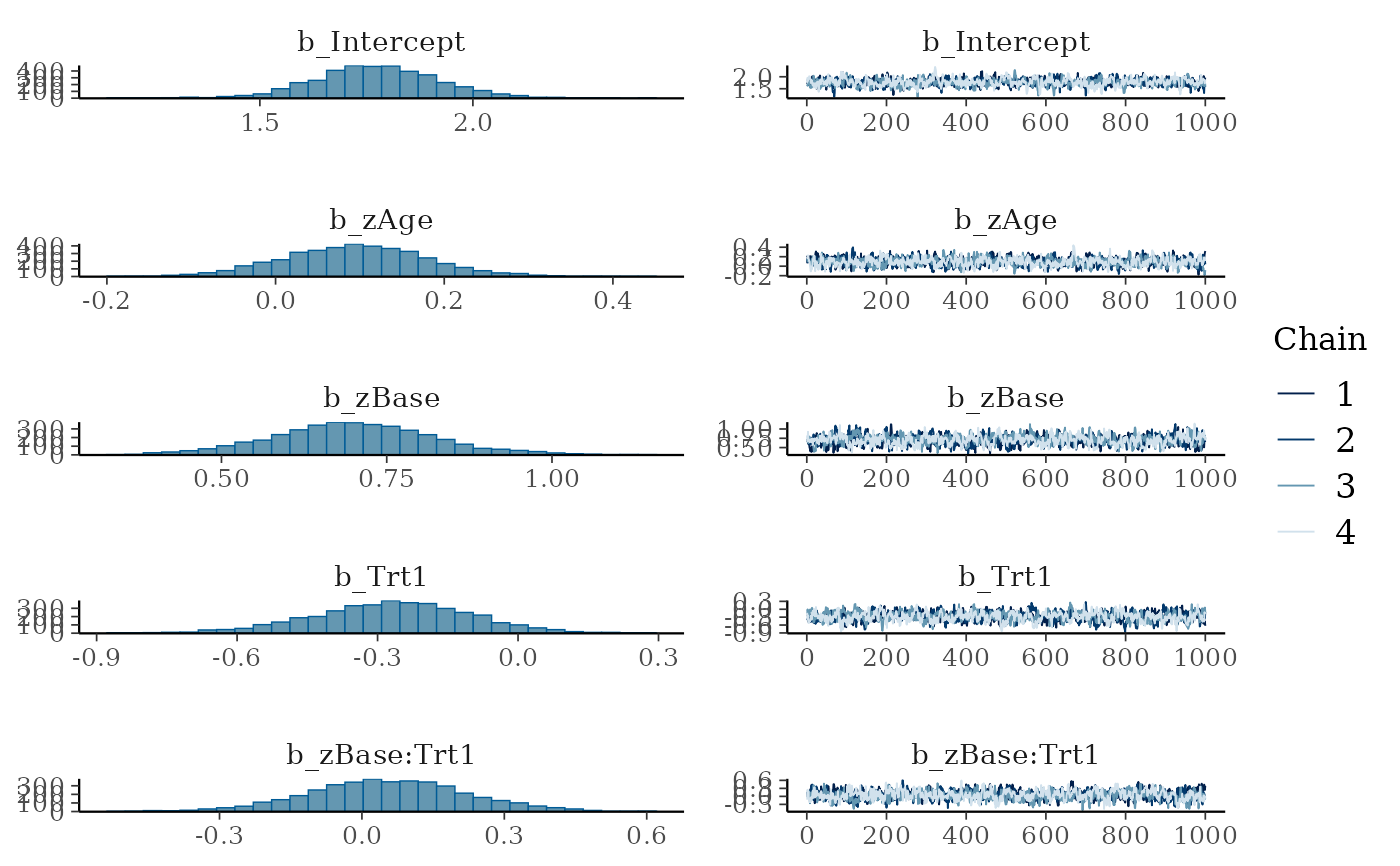
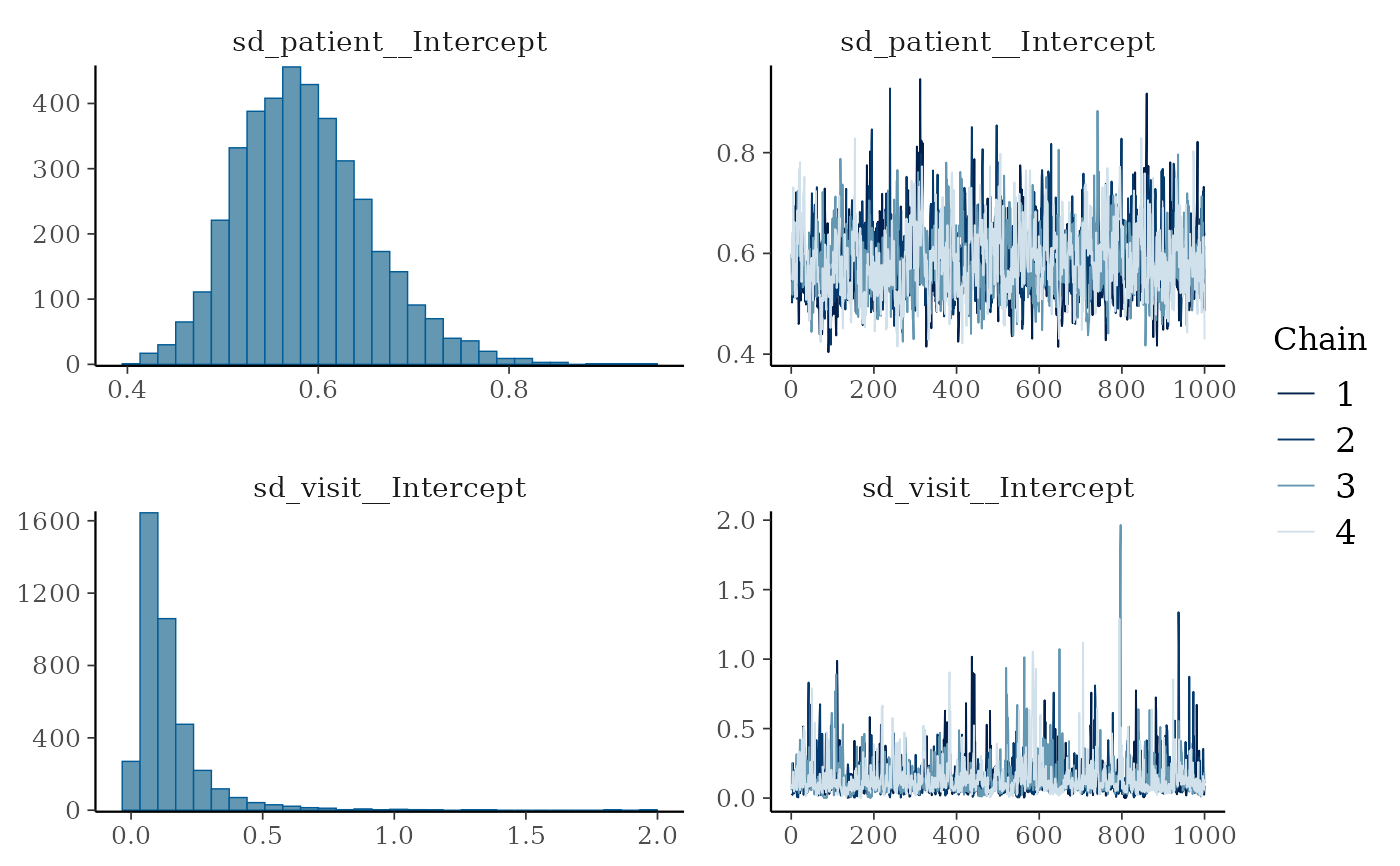
plot(fit)
 ## plot population-level effects only
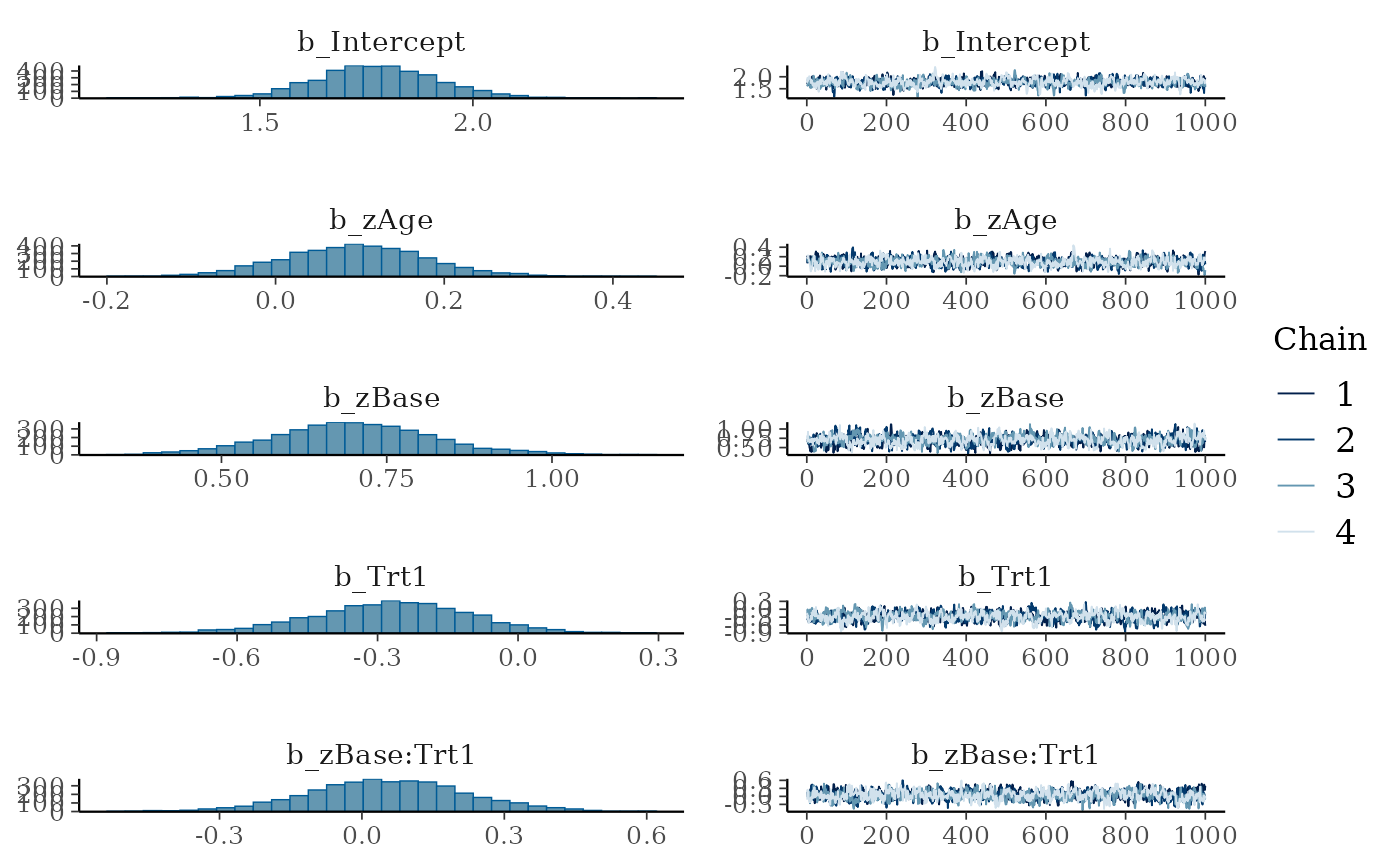
plot(fit, variable = "^b_", regex = TRUE)
## plot population-level effects only
plot(fit, variable = "^b_", regex = TRUE)
 # }
# }